Boeing’s 777X was supposed to redefine widebody aviation. Instead, it has redefined what it means to miss deadlines. Launched in 2013 with promises of 2020 deliveries, the program now targets 2027 for first customer handovers, making it seven years behind schedule. That puts the 777X among aviation’s most troubled programs, competing with legendary delay champions like the Airbus A380 and Boeing’s own 787 Dreamliner.
What makes the 777X delays particularly remarkable isn’t just their duration. It’s the sheer variety of things that have gone wrong. Doors blowing off in pressurization tests. Uncommanded pitch events during flight testing. Engine pylons cracking on multiple test aircraft. Each problem has added months or years to certification timelines, and each has cost Boeing billions in charges, customer compensation, and reputational damage already battered by the 737 MAX crisis.
The Promise That Launched a Thousand Headaches
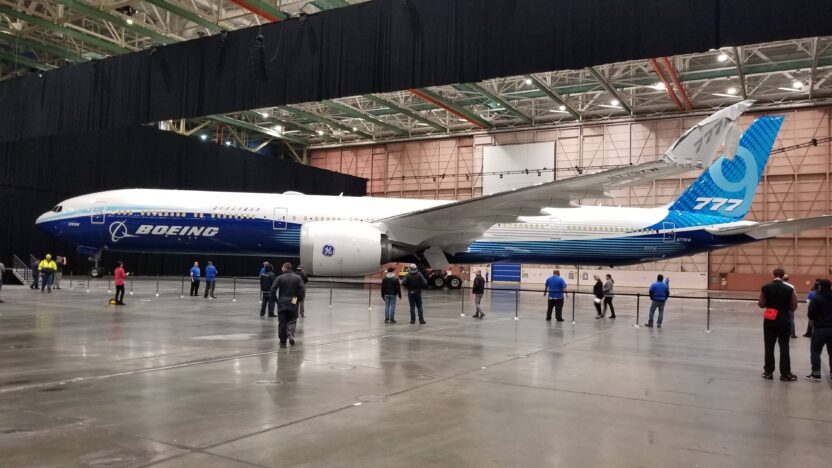
When Boeing announced the 777X family in 2013, the value proposition seemed compelling. Take the successful 777 platform, stretch it, add composite folding wings from 787 technology, mate it to the massive new GE9X engine, and create the most efficient twin-engine widebody ever built. The 777-9 would carry over 400 passengers farther and more efficiently than anything else in its class. Airlines loved it. Emirates alone ordered 123 aircraft.
The folding wingtips became an engineering marvel. The wings span 235 feet, too wide for standard airport gates designed for 213-foot wingspans. So Boeing designed 11-foot wingtip sections that fold up hydraulically after landing, allowing the aircraft to fit existing infrastructure. The mechanism completes its fold in 20 seconds.
But turning concepts into certified aircraft proved vastly more complex than Boeing anticipated. The first warning sign came in September 2019, before the aircraft even flew. During an extreme pressurization test, a cargo door blew off one of the test aircraft sitting in a hangar. Boeing had to redesign the door and rerun certification tests.
The Flight Testing Nightmare Begins
 Photo by : Jacob Mathers / Unsplash
The 777X finally took its maiden flight in January 2020, already behind schedule. Within months, testing revealed problems with the flight control system that forced Boeing to suspend flights in December 2020. The uncommanded pitch event during testing echoed the kinds of control issues that had plagued the 737 MAX, though Boeing insisted this was different and less severe.
Then came the regulatory environment shift. After two 737 MAX crashes killed 346 people and grounded the fleet for 20 months, the FAA dramatically tightened certification standards. The cozy relationship where Boeing essentially certified its own aircraft ended. The agency now scrutinizes every aspect of new aircraft programs, demanding exhaustive testing and documentation that previous generations of planes never faced.
This stricter oversight extended certification timelines for the 777X and every other Boeing program in development. Flight testing resumed in July 2024 after years of modifications and regulatory reviews, only to hit another catastrophic setback. In August 2024, routine inspections following a test flight in Hawaii discovered structural damage in the thrust link connecting the GE9X engines to the wings. Further inspection found cracks in the same component on other test aircraft.
The entire test fleet was grounded again. Boeing had to redesign the engine mounting hardware, manufacture new parts, install them on all test aircraft, and rerun certification tests. Flight testing didn’t resume until January 2025, putting the program even further behind.
The GE9X Engine Saga
The 777X’s delays can’t be blamed entirely on Boeing. General Electric’s GE9X engine, which powers the aircraft exclusively, has contributed its own share of problems. As the world’s largest and most powerful commercial jet engine with 134 inches of fan diameter, the GE9X represents bleeding-edge technology. That means bleeding-edge development challenges.
A compressor anomaly delayed the first flight in 2019, requiring several months of redesign work. In October 2022, another technical issue with a GE9X engine forced Boeing to pause the entire test program while GE investigated. Each engine problem ripples through the certification schedule because Boeing can’t complete flight testing without functioning, certifiable engines.
The engine itself performs impressively when working correctly. It delivers 105,000 pounds of thrust while burning 10 percent less fuel than previous generation engines. But getting it certified and reliable enough for commercial service has taken far longer than either GE or Boeing anticipated.
The Financial Carnage Nobody Wants to Talk About
 Photo by : Pham Huynh Tuan Vy / Pexels
Boeing has now taken over $15 billion in pre-tax charges on the 777X program. Fifteen billion dollars in losses on an aircraft that hasn’t delivered a single paying customer yet. The delays cost money directly through extended development and testing. They cost money indirectly through compensation payments to airlines for missed delivery schedules.

Airbus vs Boeing: Who Is Winning the Aircraft Orders Race in 2026?
CEO Kelly Ortberg acknowledged in September 2025 that “even a minor schedule delay on the 777 program has a pretty big financial impact.” With over 20 completed airframes sitting in storage waiting for certification, each month of delay prevents Boeing from converting billions of inventory into revenue. Those aircraft will need modifications to meet final certification standards before delivery, adding more costs.
The timing couldn’t be worse for Boeing’s cash position. The company is burning through cash reserves while dealing with 737 MAX production issues, 787 delivery delays, and labor strikes. The 777X was supposed to be a cash cow. Instead, it’s another drain on resources Boeing desperately needs elsewhere.
How Airlines Are Coping With the Endless Wait
Lufthansa, designated as the launch customer in 2013, has revised its fleet plans so many times it probably needs a spreadsheet to track the changes. The German carrier initially planned to debut the 777-9 in 2020, then 2022, then 2024. Now it’s preparing for 2026 or possibly 2027 delivery. Lufthansa designed its new Allegris cabin specifically for the 777X, but ended up debuting that cabin on refurbished A350s and 747-8s because the 777X still doesn’t exist.
Emirates has been even more vocal about frustration. President Tim Clark, who runs the world’s largest widebody airline and holds 115 777X orders, has repeatedly criticized Boeing’s handling of the program. The delays force Emirates to keep aging 777-300ERs flying longer than planned, increasing maintenance costs and missing opportunities to improve fuel efficiency and passenger experience.
Some airlines have hedged their bets by ordering more Airbus A350-1000s to fill capacity gaps. The A350-1000 carries fewer passengers than the 777-9, about 350 to 400 versus 400-plus, but it’s available now and proven reliable. For slot-constrained airports, the 777X’s extra capacity still matters. For airlines that need aircraft operating today rather than someday, Airbus provides the only option.
The Counterargument That Still Gives Boeing Hope
 Photo by : Joe Ambrogio / Pexels
Despite everything, airlines haven’t abandoned the 777X entirely. Boeing landed 84 new 777X orders in 2025 through October, suggesting the market still believes in the concept. Some of those deals came with political support during trade negotiations under President Trump, but airlines don’t order aircraft they don’t actually want.
The aircraft’s specifications remain compelling. No other twin-engine widebody matches the 777-9’s combination of capacity, range, and efficiency when it eventually enters service. For mega-hubs like Dubai, London Heathrow, or Singapore, the ability to move 400-plus passengers efficiently through slot-constrained airports justifies waiting for the right aircraft rather than settling for second best.
Cathay Pacific recently added 14 more 777-9s to its order book, bringing its total to 35 aircraft. That vote of confidence came despite full awareness of the delays and uncertainty. The Hong Kong carrier is building its long-haul recovery strategy around the 777X, indicating faith that Boeing will eventually deliver a superior product worth the wait.
Airlines also recognize that the intense scrutiny and extended testing will ultimately produce a very mature, reliable aircraft. Every problem discovered during testing is one that won’t surprise operators after service entry. The 787’s early reliability issues stemmed partly from insufficient testing. The 777X won’t have that excuse.
What Actually Needs to Happen for 2027 Delivery
Boeing must complete a mountain of remaining certification work to hit even the revised 2027 target. As of late 2025, the program had accumulated about 4,100 test flight hours across five test aircraft. That sounds substantial until you realize how many test hours remain.
The FAA granted Type Inspection Authorization Phase 3 approval in November 2025, marking a critical milestone but also the beginning of the most challenging certification phase. This involves rigorous inspections, extensive documentation, and real-world testing under close FAA supervision. Future testing includes simulating ice formations on wings, evaluating braking performance on wet runways, and extreme weather trials.
Boeing needs to average over 140 flight test hours per month through mid-2026 to stay on schedule. That requires roughly 4.7 hours of test flying daily including weekends. With multiple test aircraft, this remains feasible if well-planned. But the company is also simultaneously certifying the 737 MAX 7 and MAX 10, both dealing with their own engine nacelle issues. Managing three complex certification programs simultaneously tests Boeing’s organizational capacity.
The 777X saga demonstrates how modern aircraft certification has fundamentally changed post-737 MAX. Programs can’t muscle through on corporate momentum or political influence anymore. The FAA won’t be rushed, and rightfully so given what happens when regulators get too cozy with manufacturers. For Boeing, that means accepting reality: the 777X enters service when it’s genuinely ready, not when the schedule demands it. After seven years of delays, a few more months to get it right matters far less than the next several decades of safe operation.
Related Aviation News
 Photo by : Wikimedia Commons
Airbus vs Boeing Narrow-Body Battle: Why the A321neo Is Winning Orders
The Airbus A321neo dominates narrow-body aircraft orders with over 7,300 commitments, beating Boeing's 737 MAX through superior capacity…
Airbus vs Boeing: Who Is Winning the Aircraft Orders Race in 2026?
Boeing beat Airbus on 2025 orders for first time in 7 years with 1,173 vs 889. Early 2026…