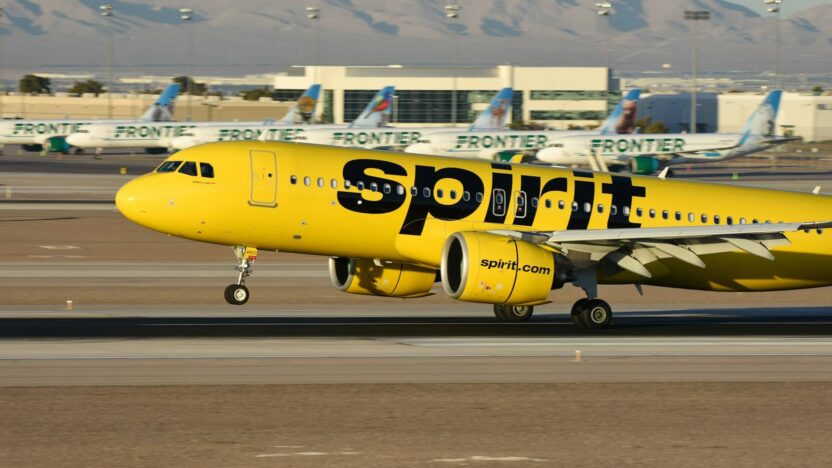
Spirit Airlines refuses to die. After two Chapter 11 bankruptcy filings in less than a year, a blocked merger, a rejected takeover, mass furloughs, and a fleet slashed by more than half, the ultra-low-cost carrier announced on February 24 that it has reached an agreement in principle with its secured creditors and DIP lenders on the key terms of a restructuring support agreement. The plan: exit bankruptcy by late spring or early summer 2026 as a smaller, leaner, and theoretically profitable airline.
CEO Dave Davis called it “months of hard work” culminating in a transformation. The financial headline is dramatic: Spirit expects to reduce its total debt and lease obligations from $7.4 billion before the filing to roughly $2.1 billion after emergence. That’s $5.3 billion wiped off the books. On paper, it’s a lifeline. Whether it’s enough to actually compete in one of the most ruthless airline markets on earth is the question nobody at Spirit headquarters can answer with certainty.
How Spirit Got Here: A Timeline of Turbulence
Understanding where Spirit stands today requires rewinding through a genuinely chaotic few years. The short version: everything that could go wrong did go wrong, often simultaneously.
In February 2022, Frontier Airlines agreed to acquire Spirit for $2.9 billion. Then JetBlue showed up with a competing $3.8 billion cash offer, Spirit’s shareholders preferred the richer bid, and Frontier walked away. JetBlue’s acquisition sailed through internal approvals but hit a wall in court. In January 2024, federal judge William Young blocked the merger on antitrust grounds. JetBlue formally abandoned the deal in March 2024. Spirit was suddenly alone, carrying approximately $3.3 billion in debt, with no strategic partner and no clear path forward.
The airline filed for Chapter 11 in November 2024, becoming the first major US airline to do so since American Airlines in 2011. That initial restructuring was a prepackaged deal: bondholders converted $795 million in debt to equity, existing shareholders got wiped out, and Spirit emerged in March 2025 after roughly four months in court.
It wasn’t enough. The first bankruptcy addressed the balance sheet but left the underlying operational problems untouched. Spirit reported a loss of nearly $257 million between mid-March and the end of June 2025 alone. On August 29, 2025, Spirit filed for Chapter 11 again. A double bankruptcy in under twelve months. In aviation, that’s nearly unheard of.
What the New Deal Actually Includes
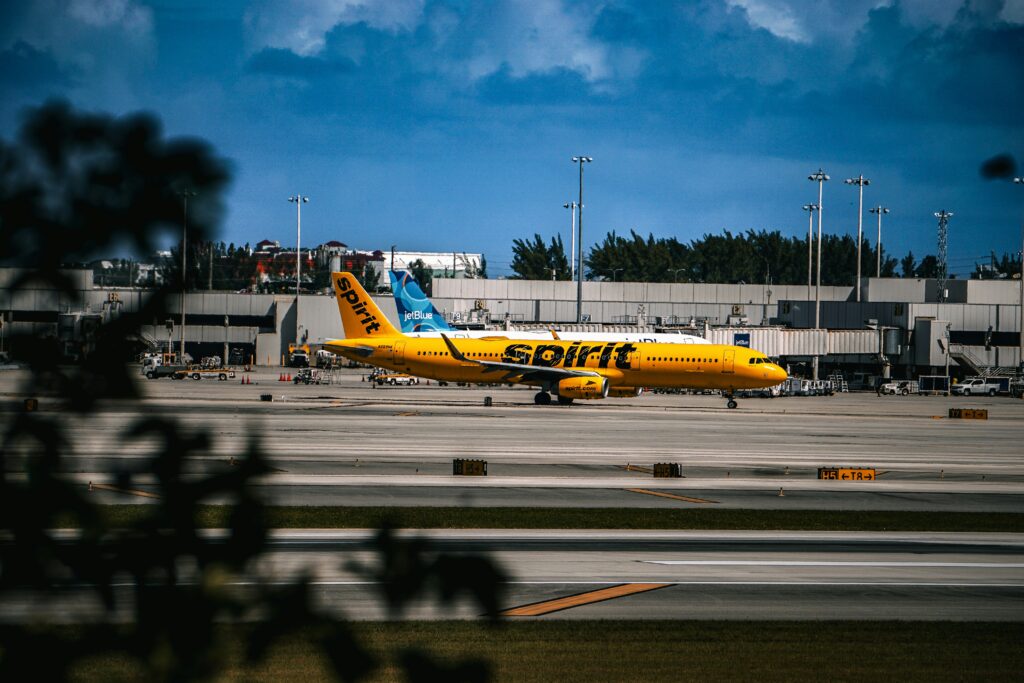 Photo by : Randolph Rojas / Unsplash
The agreement in principle announced on February 24 covers the key terms of a restructuring support agreement between Spirit and its existing DIP (debtor-in-possession) lenders and secured noteholders. It’s not a final plan, and it still requires court confirmation, but it represents a concrete framework for emergence.
The numbers tell the story. Spirit’s aggregate debt and lease obligations drop from $7.4 billion pre-filing to approximately $2.1 billion post-emergence. Annualized fleet costs are being cut by roughly $550 million, a 65 percent reduction from pre-bankruptcy levels. The airline has already exited 14 airports, rejected leases for more than 80 aircraft, closed maintenance stations in Baltimore and Chicago, and auctioned off 20 Airbus jets.
The fleet itself is unrecognizable compared to a year ago. Spirit entered its second bankruptcy operating 214 aircraft. After all pending sales and lease returns, the airline expects to operate approximately 94 narrowbody jets, split between 28 owned and 66 leased aircraft. That’s a 56 percent reduction. The emerging fleet will consist primarily of older Airbus A320ceo family aircraft, with Spirit actively shedding its newer, more expensive A320neo variants to reduce lease costs.
The human toll has been significant. Approximately 1,800 flight attendants were furloughed in December 2025, roughly a third of the entire cabin crew. In February 2026, Spirit recalled 500 of those flight attendants ahead of the spring break travel season. Some 150 corporate and operational jobs were eliminated. Pilot furloughs were initially planned but largely offset by natural attrition.
The “New Spirit” Strategy
The airline emerging from Chapter 11 will bear only a passing resemblance to the Spirit of 2019 or even 2023. Management has outlined three strategic pillars.
The first is network optimization. Spirit will concentrate its flying on routes and time periods with the strongest consumer demand, primarily out of Fort Lauderdale, Orlando, the New York metro area, and Detroit. Low-demand flying on Tuesdays and Wednesdays gets reduced. Aircraft utilization goes up during peak travel windows.
The second pillar is a premium pivot. Spirit plans to expand its “Spirit First” and Premium Economy offerings while enhancing its Free Spirit loyalty program and co-branded credit card. The Big Front Seat, which became a quiet hit with budget-conscious travelers who wanted a little extra room, is getting more prominence. The idea is to generate higher revenue per passenger without fully abandoning the ultra-low-cost foundation that built the brand.
The third is the balance sheet itself. With $5.3 billion in obligations eliminated, Spirit argues it will emerge with a cost structure that restores its pricing advantage against legacy carriers and even competitors like Frontier.
Dave Davis framed the vision succinctly: Spirit will be “a strong, leaner competitor that is positioned to profitably deliver the value American consumers expect at a price they want to pay.”
The Counterargument: Can a Half-Sized Spirit Actually Work?
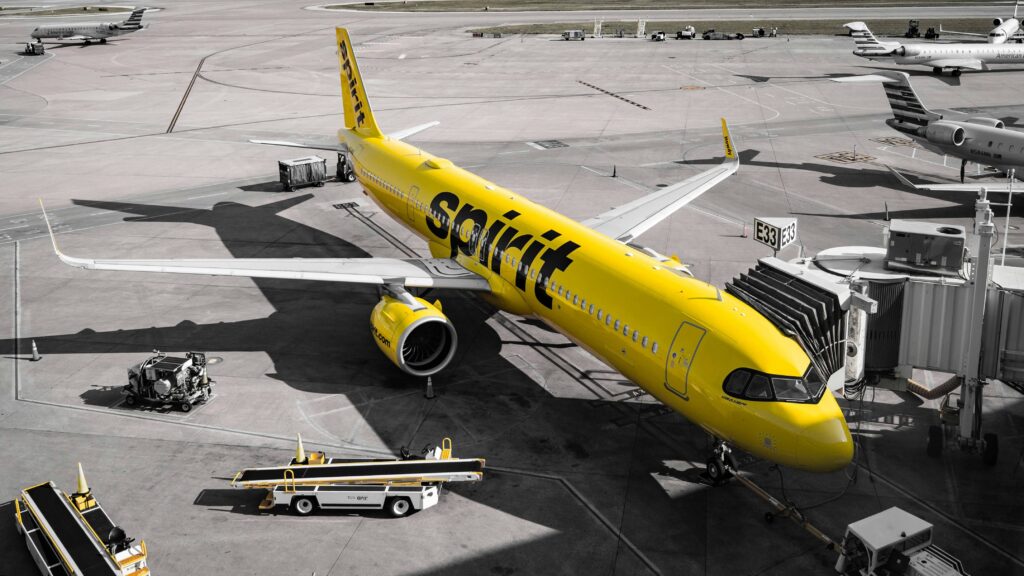 Photo by : Joe NG / Unsplash
Here’s where healthy skepticism earns its place. Spirit’s restructuring solves the debt problem. What it doesn’t solve is the scale problem.
Aviation consultant John Grant of JG Aviation has pointed out that by August 2026, Spirit’s projected domestic capacity share will be around 2.4 percent. That compares to roughly 4 percent for Frontier. In Grant’s words, the airline will be “a marginal player in the total market” operating in an environment where competitors are “ruthless in their commercial activities and networks.”
Scale matters in the airline business because fixed costs don’t shrink proportionally when you cut flying. Airport infrastructure, technology systems, training, and corporate overhead all require a baseline investment whether you fly 94 aircraft or 214. Spirit’s per-unit cost advantage gets harder to maintain as the denominator shrinks.
There’s also the fleet composition issue. By shedding newer A320neo and A321neo aircraft (some delivered as recently as 2024) to escape expensive leases, Spirit is retaining a fleet of older, less fuel-efficient A320ceos. That’s a rational short-term financial decision that creates a long-term cost problem. Fuel is the second-largest expense for any airline. Flying older jets means burning more of it per seat mile, which erodes the very cost advantage Spirit needs to survive at low fares.
And then there’s the competition problem. During the eighteen months Spirit spent in and out of bankruptcy, every major airline moved into the vacuum. American, Delta, and United took over Spirit’s gates at multiple airports. Frontier expanded on routes Spirit abandoned. Those passengers found other options. Winning them back means competing on price against carriers with deeper pockets, newer fleets, and more comprehensive networks.
CNN reported that this upcoming summer, Spirit will offer nearly 40 percent fewer flights and seats than during the same period in 2024. That’s not a temporary dip. That’s a structural reset.
The Premium Paradox
Spirit built its brand on being the cheapest option in the sky. Yellow planes. No frills. The Big Front Seat was basically a larger economy seat sold at a markup, and it worked precisely because everything around it was so aggressively stripped down.
Now Spirit wants Premium Economy and expanded First Class options. There’s logic here: the US airline market has tilted sharply toward premium post-pandemic, with legacy carriers reporting their highest revenue growth from premium cabins.
But Spirit’s earlier attempts to move upmarket didn’t work. The airline’s 2024 effort to introduce higher-priced bundled fares alienated its price-sensitive core customers without attracting premium travelers. The product wasn’t compelling enough for the premium segment, and the pricing drove away the budget flyers who had been Spirit’s bread and butter. Walking that tightrope is extraordinarily difficult, and nothing about this restructuring has changed the fundamental challenge of selling premium seats under a brand built on no-frills flying.
What Happens Next
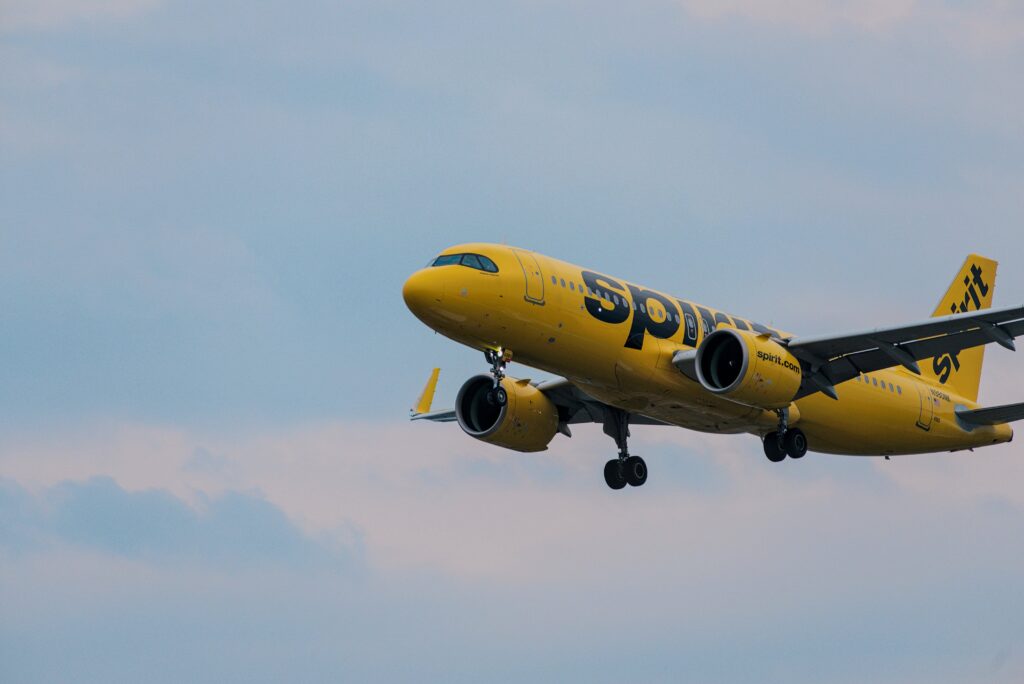 Photo by : Mehmet Suat Gunerli / Pexelsls
Spirit’s legal team will work with the US Bankruptcy Court for the Southern District of New York to set a confirmation schedule. If the restructuring support agreement is finalized and approved, the airline targets emergence by late spring or early summer 2026.
Passengers can continue to book and fly Spirit throughout the process. Tickets, credits, and Free Spirit loyalty points remain valid. The route network will be smaller, but flights continue.
The broader industry will be watching closely. Ultra-low-cost carriers serve as a pricing check on the entire domestic market. Research has consistently shown that when a ULCC enters a route, average fares drop. When one exits, fares creep back up. A permanently smaller Spirit means less competitive pressure on American, Delta, United, and Southwest in markets Spirit has abandoned.
Spirit Airlines has proven one thing over the past two years: it is extremely difficult to kill. But survival is the floor, not the ceiling. Emerging from Chapter 11 with a clean balance sheet and 94 aircraft puts Spirit back in the sky. Whether it stays there depends on whether the airline can do something it has failed to do for years: consistently earn more money than it spends.
The $5.3 billion in erased debt buys Spirit another chance. Or, more accurately, a third one.