The future of flying was supposed to arrive by 2035. Airbus promised a hydrogen-powered passenger aircraft that would emit nothing but water vapor, a technological leap that would revolutionize commercial aviation and help the industry hit net zero emissions targets. There was just one problem: actually building it turned out to be harder than anticipated.
In early 2025, Airbus pushed back its ZEROe hydrogen aircraft program by five to 10 years, slashed the annual budget by 25 percent, and moved engineers to other projects. After burning through $1.7 billion in research and development, the European manufacturer admitted that the hydrogen economy, airport infrastructure, and critical technologies are running years behind 2020 assumptions. CEO Guillaume Faury summed up the dilemma when he worried about creating a “Concorde of hydrogen,” referring to the beautiful supersonic jet that flew for 27 years but never made commercial sense.
What Airbus Actually Promised and Why Everyone Believed It
When Airbus unveiled three ZEROe concept aircraft in September 2020, the aviation industry took notice. These weren’t vague artist renderings or PowerPoint fantasies. Airbus showed a turbofan design for 120 to 200 passengers, a turboprop for up to 100 passengers, and a futuristic blended-wing body configuration. Each represented a different technological pathway toward zero-emission flight, and Airbus committed to picking one and bringing it to market by 2035.
The timing made sense. Aviation accounts for roughly 2.5 percent of global carbon dioxide emissions, and that percentage was climbing as air travel rebounded from pandemic lows. Pressure was mounting from regulators, environmental groups, and passengers who increasingly cared about the climate impact of their travel choices. Airlines needed a solution, and hydrogen looked like the answer.
Hydrogen’s appeal is straightforward. When you burn it or run it through a fuel cell, the only byproduct is water. No carbon dioxide. No nitrogen oxides. Just H2O. The energy-to-mass ratio is exceptional, meaning you get tremendous power from relatively little fuel by weight. The technology isn’t even particularly new. Rockets have run on liquid hydrogen for decades. The automotive industry has built hydrogen fuel cell vehicles. How hard could adapting it to aircraft be?
The Technology Airbus Finally Settled On
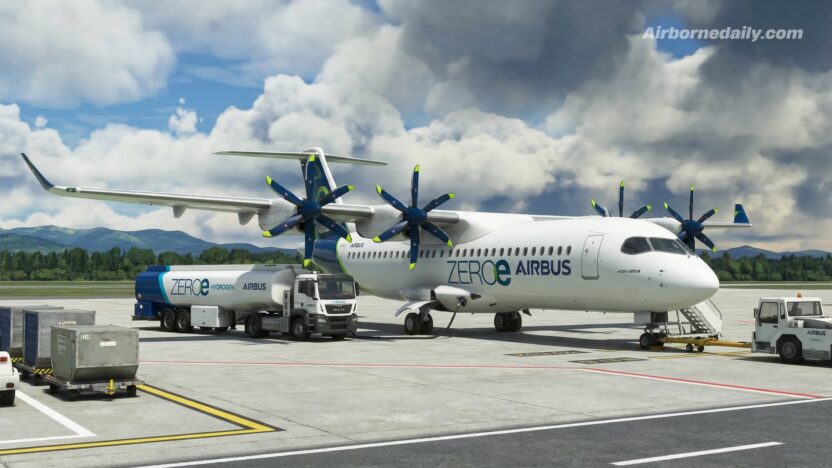
After five years of experimentation, Airbus made a critical decision in early 2025: they’re going all-in on hydrogen fuel cells powering electric motors, abandoning earlier concepts that involved burning hydrogen in modified jet engines. The latest ZEROe design features four electric propellers, each driven by its own fuel cell stack that converts liquid hydrogen into electricity.
The fuel cells themselves represent a significant engineering challenge. Airbus founded Aerostack, a joint venture with German company ElringKlinger, to develop fuel cell stacks powerful enough for aviation while keeping weight acceptable. In 2023, they successfully tested a 1.2-megawatt system, which sounds impressive until you realize a typical narrow-body jet engine produces around 27,000 pounds of thrust.
Then there’s the hydrogen storage problem. Liquid hydrogen needs to be kept at minus 253 degrees Celsius, which is only 20 degrees above absolute zero. That requires cryogenic tanks made from advanced composite materials. Airbus built a facility called Breadboard in Grenoble, France, to test these storage systems at full scale. The current concept calls for two tanks, each holding roughly 750 kilograms of liquid hydrogen.
At their March 2025 summit, Airbus revealed the updated vision: a relatively modest 100-passenger aircraft capable of flying 1,000 nautical miles. That’s a significant step down from earlier concepts promising 200 passengers flying 2,000 nautical miles. The range barely covers New York to Chicago. For context, a modern Airbus A320neo can carry 180 passengers nearly 4,000 nautical miles on conventional jet fuel.
Why the Hydrogen Economy Isn’t Cooperating
The aircraft technology challenges pale compared to the infrastructure nightmare. Even if Airbus builds a perfect hydrogen-powered plane tomorrow, it would be useless without a global network of hydrogen production, storage, and fueling facilities at airports.
Right now, that infrastructure basically doesn’t exist. Producing hydrogen from renewable energy at the scale aviation requires remains extraordinarily expensive. Most hydrogen today comes from natural gas through a process that releases carbon dioxide, defeating the entire purpose. Green hydrogen made via electrolysis using renewable electricity costs several times more.
Airports would need completely new fueling systems. Jet fuel gets pumped through existing infrastructure refined over 70 years. Liquid hydrogen requires cryogenic storage and transfer equipment that most airports don’t have and can’t afford without guaranteed demand. It’s a classic chicken-and-egg problem.
Airbus launched a Hydrogen Hubs at Airports program, recruiting over 220 airports plus airlines and fuel companies as partners. That sounds impressive until you consider there are roughly 41,000 airports worldwide.

Airbus vs Boeing: Who Is Winning the Aircraft Orders Race in 2026?
The Competition From Sustainable Aviation Fuel Nobody Talks About Enough
Here’s where things get politically uncomfortable for Airbus. While they’ve been chasing hydrogen dreams, the aviation industry has made significant progress on a simpler solution: sustainable aviation fuel, or SAF. This is jet fuel made from renewable sources like cooking oil, agricultural waste, or captured carbon dioxide. The beauty of SAF is that it works in existing aircraft with existing engines through existing infrastructure.
SAF can reduce lifecycle carbon emissions by up to 80 percent compared to conventional jet fuel, and it’s available today. Yes, it costs more. Yes, production needs to scale up. But those are solvable problems that don’t require inventing entirely new aircraft propulsion systems and rebuilding global airport infrastructure.
Major airlines are already buying SAF in growing quantities. United Airlines, KLM, and Lufthansa have all made significant commitments. Boeing is heavily backing SAF as the primary path to decarbonization. When you can achieve 80 percent emissions reduction using technology that already works versus waiting until 2040 for hydrogen aircraft that might carry 100 people a thousand miles, the SAF argument becomes compelling.
Airbus insists they’re pursuing both pathways, developing a next-generation single-aisle aircraft for the late 2030s that will use conventional engines burning SAF while simultaneously working on hydrogen for the longer term. But with budget cuts and timeline delays, it’s clear which pathway is getting prioritized.
Why Some Aviation Experts Think Hydrogen Still Makes Sense
The counterargument from hydrogen advocates is that SAF, while useful, can’t get aviation all the way to net zero. Even with 80 percent reductions, you’re still emitting carbon. For aviation to truly hit zero emissions, you need either hydrogen or battery-electric aircraft, and batteries remain far too heavy for anything beyond short regional flights.
Hydrogen also becomes more attractive on longer routes where the weight savings matter most. Liquid hydrogen weighs less than conventional jet fuel for the same amount of energy, which means aircraft could theoretically fly farther with lighter fuel loads. On a trans-Pacific flight, that advantage compounds over hours of flying time.
Glenn Llewellyn, Airbus’s vice president for zero-emission aircraft, remains bullish despite the delays. At the March 2025 summit, he reaffirmed that “hydrogen can and will fly,” arguing that the technology progress Airbus has made proves the concept works. The 1.2-megawatt fuel cell system they demonstrated wasn’t theoretical. It ran. It produced power. The liquid hydrogen tanks they’re testing aren’t vaporware. They exist and function.
The regulatory framework is slowly taking shape too. The UK Civil Aviation Authority expanded its Hydrogen Challenge program in 2025, signaling government support for developing hydrogen aviation capabilities. European aviation groups, while downgrading hydrogen’s near-term contribution to net zero targets, haven’t abandoned it entirely. The bet is that by the 2040s, green hydrogen production costs will have dropped, airport infrastructure will have caught up, and the technology readiness will finally align with commercial viability.
What Actually Happens Next
Airbus isn’t giving up on hydrogen, despite scaling back ambitions. They’re continuing ground testing of the integrated propulsion system, with comprehensive system validation planned for 2027 at their Electric Aircraft System Test House in Munich. The fuel tank development continues in Nantes and Bremen. Research into potential game-changing technologies like cryogenic superconductivity proceeds at a slower pace with reduced budgets.
But the realistic timeline now stretches to 2040 to 2045 for commercial entry into service, assuming everything goes right. That’s 15 to 20 years from now. For context, Airbus announced the A320neo in 2010 and had it flying passengers by 2016. Hydrogen aircraft are proving orders of magnitude more complex.
The question facing aviation is whether hydrogen represents the inevitable future of flight or an expensive distraction from more practical solutions. The answer probably isn’t binary. Regional aircraft and shorter routes might see hydrogen adoption earlier, while long-haul intercontinental flying might stick with SAF-burning conventional engines for decades.
What’s certain is that aviation’s path to net zero won’t follow a single technology roadmap. Airlines will use whatever combination of SAF, hydrogen, electric propulsion, operational improvements, and offsetting gets them to their emissions targets most cost-effectively. Airbus hedging their bets across multiple technologies isn’t indecisiveness. It’s pragmatism in the face of enormous uncertainty about which pathways will actually prove viable at commercial scale.
After spending $1.7 billion learning that hydrogen aircraft are harder than expected, Airbus now knows more than any company on Earth about what it takes to make them work. Whether that knowledge leads to revolutionary zero-emission flying in 2045 or becomes a cautionary tale about technological overreach remains to be seen. Either way, the next two decades will determine if we fly through the skies on hydrogen dreams or pragmatic alternatives.
Related Aviation News
Airbus vs Boeing: Who Is Winning the Aircraft Orders Race in 2026?
Boeing beat Airbus on 2025 orders for first time in 7 years with 1,173 vs 889. Early 2026…
 Photo by : Isaac Struna / Unsplash
Delta Boosts Airbus Fleet With 97 A321neos as Regional Lessor Enters Aviation
Delta expanded A321neo orders to 97 aircraft and added 31 widebodies while TrueNoord entered its first Airbus deal…
 Photo by : Troy Mortier / Unsplash
Airbus A380 May Never Return to Production, But Its Legacy Still Shapes Aviation
Airbus A380 production ended in 2021 after $25B investment. While 159 aircraft still fly, the superjumbo's return remains…